When people think about multi-level marketing (MLMs), the conversation usually revolves around one question: Do people actually make money? It’s an understandable question, but after leaving two MLMs myself, I realised the money wasn’t the part that stayed with me. What stayed with me were the emotions of the hope, the pressure, the awkwardness and the gradual feeling that I was slowly losing myself.
Like many people, I didn’t join because I was chasing instant wealth. I joined because I wanted what so many of us want, a little more freedom, more financial security and the exciting possibility of building a ‘business’ that belonged to me. I hated my 9-5 office job, I had a degree in Tourism Management and and loved the idea of earning extra money while helping people travel. It sounded flexible, positive and full of opportunity.
Looking back, I don’t think that makes me foolish. The recruitment wasn’t filled with pressure or manipulation in the beginning. It was filled with excitement. I was shown a video and photographs of laptops on beaches, stories of people travelling the world and promises that hard work could create a completely different future. There were smiling faces, supportive messages and a contagious belief that normal people could build extraordinary lives. It wasn’t difficult to understand why people believed it. It sounded like a dream job, maybe a little too good to be true but I didn’t think much of it at the time. I paid £180 to join the company, when looking back that was not a wise move. There is no business or company worth working for that will make you pay to join. This is one of my many personal regrets when getting involved with a multi-level marketing company. I should of done more research.
That’s the part very few people talk about. Most people don’t join because they’re greedy. They join because they’re hopeful and at first everything feels exciting. You buy the notebook, organise your planner, save motivational quotes and imagine the person you’re about to become. You genuinely believe you’re investing in yourself and every training session feels like another step towards freedom and every seminar convinces you that success might only be one breakthrough away. You look around the room and see people applauding one another, celebrating promotions and talking about how this opportunity changed their lives. For a while, it’s difficult not to believe that yours could change too.
What nobody explains is how gradually your life begins to revolve around the business.
It doesn’t happen overnight. One day you’re simply making an extra social media post. Then you’re replying to comments, following up messages, attending another team call, creating graphics, refreshing notifications and convincing yourself that next month will be different. Before long, you’re spending hours every evening working without really noticing how much of your personal life or money has quietly disappeared.
For me, this became especially difficult because I’m naturally introverted and socially anxious. I don’t enjoy cold calling strangers. I overthink conversations, I rehearse phone calls before making them and often avoid unnecessary social interactions altogether. Yet somehow I found myself trying to convince complete strangers to buy products and sending awkward messages to people I hadn’t spoken to for years.
I still remember staring at my phone before sending one of those familiar “Hey hun, I was just thinking about you and wanted to reach out…” messages. I rewrote it several times, trying to make it sound less scripted, less desperate and more natural. The moment I finally pressed send, I instantly regretted it. Then came the waiting, constantly checking whether they’d read it, wondering why they hadn’t replied and convincing myself that I simply needed to become more confident.
Over time something else changed that I hadn’t expected. I stopped seeing people simply as people. Every interaction became a possible customer and every conversation carried the possibility of a sale. Looking back now, I think that’s one of the saddest parts of my experience because friendships should never feel like business opportunities.
Social media changed too. My personal profile slowly became unrecognisable, the photos of everyday life became fewer, replaced by motivational quotes, business updates and carefully crafted posts designed to attract attention and potential sales. I wasn’t really sharing my life anymore. I was creating an image of the life I hoped to have one day, some of it were just plain lies about how going out to a fancy restaurant was possible because of this business opportunity, when in fact I hadn’t earned anything since I started.
Whenever things weren’t working, there was always another explanation. I needed to stay more positive or needed to believe in myself more. I needed to work harder, post more consistently or improve my mindset. One day I stopped questioning whether the opportunity was right for me and started questioning whether I was the problem instead. I looked at my expenditure and I was losing money, on recruitment fees, products, seminars and more. I hadn’t earned anything at all which made me worry. My upline would just say that it takes a few months to start earning money, be patient.
That’s one of the hidden costs people rarely discuss.
Failure becomes deeply personal. Success is celebrated publicly with commission screenshots, promotions, applause and inspirational speeches. Struggle and failure however, stays very private and very few people post about losing money, feeling burnt out or wondering whether they’ve spent months chasing something that simply isn’t working. Those conversations usually happen quietly, behind closed doors, if they happen at all.
Ironically, it wasn’t my bank balance that finally made me leave. It was recognising that I’d become someone I didn’t particularly like. I missed having conversations that weren’t leading towards a sales pitch. I missed evenings spent relaxing instead of creating content and I missed hobbies, having fun and feeling present instead of constantly wondering what I should post next or how to influence my algorithm.
Walking away felt uncomfortable because leaving almost felt like admitting defeat. Yet with time I realised I hadn’t failed at all. I’d simply discovered that the life I truly wanted looked nothing like the one I’d been promised. I did a lot of research afterwards and found out that around 80-90% of people involved in MLMs don’t earn any money and most in fact lose money. Comprehensive structural analyses submitted to the Federal Trade Commission (FTC) reveal that across major multi-level marketing companies, over 99% of recruits lose money once all mandatory fees, startup kits, and inventory purchases are accounted for.
Today, my evenings are spent writing books, enjoying quiet moments, spending quality time with my husband, travelling when I can and making memories with the people who matter most. Ironically, the freedom I was searching for in the MLM world didn’t arrive through recruitment targets or motivational seminars.
It arrived the moment I actually stopped believing I had to build the perfect online business in order to live a meaningful life.
That’s why the biggest lesson I took away from my MLM experience has nothing to do with business.
The fact is you were never meant to recruit your friends or family. You were meant to enjoy spending time together. Years from now, none of us will look back and wish we’d recruited one more person or written one more sales post. We’ll remember the holidays we took, the conversations we shared and the people who stood beside us and the ordinary moments that quietly became extraordinary.
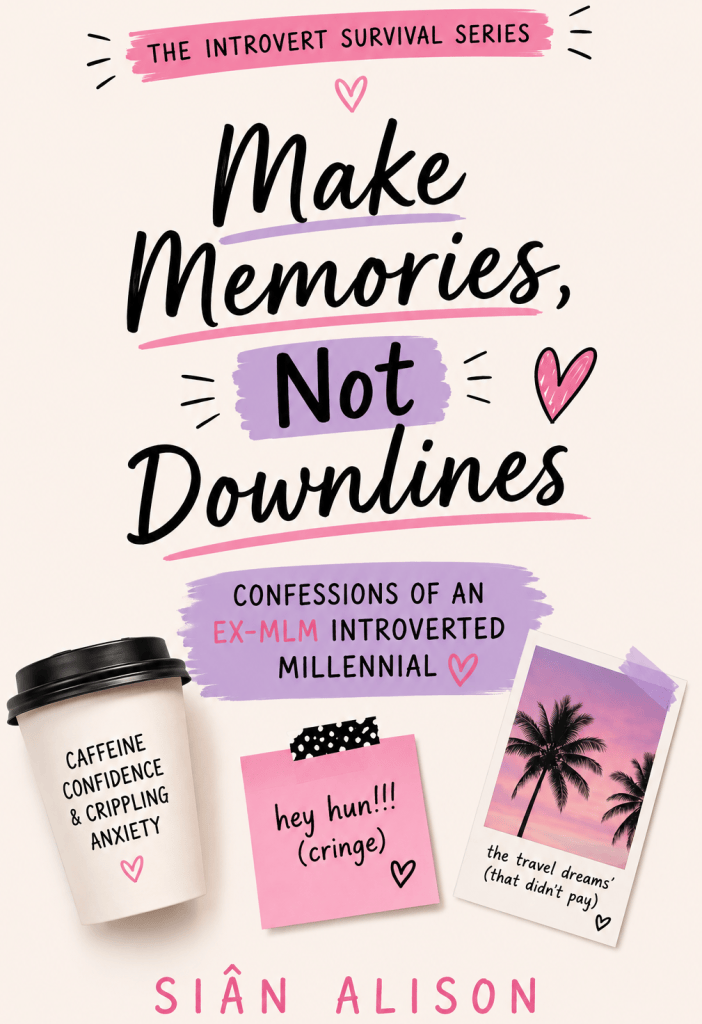
In the end, life is about making memories, not downlines.
Related to ‘Make Memories. Not Downlines’ by Siân Alison.
Enjoyed this article? 😊
Thanks for reading! If you’d like to discover more of my books then click the link to browse below👇


Leave a Reply